Outdoor Adventure Tower & Rope Course Design Guide: Structural Loads, PVDF Canopies & Park ROI
How destination theme parks, eco-resorts, and regional leisure developers stack 60+ active climbing elements onto compact footprints using multi-level adventure towers, PVDF canopies, and zero-electricity throughput.
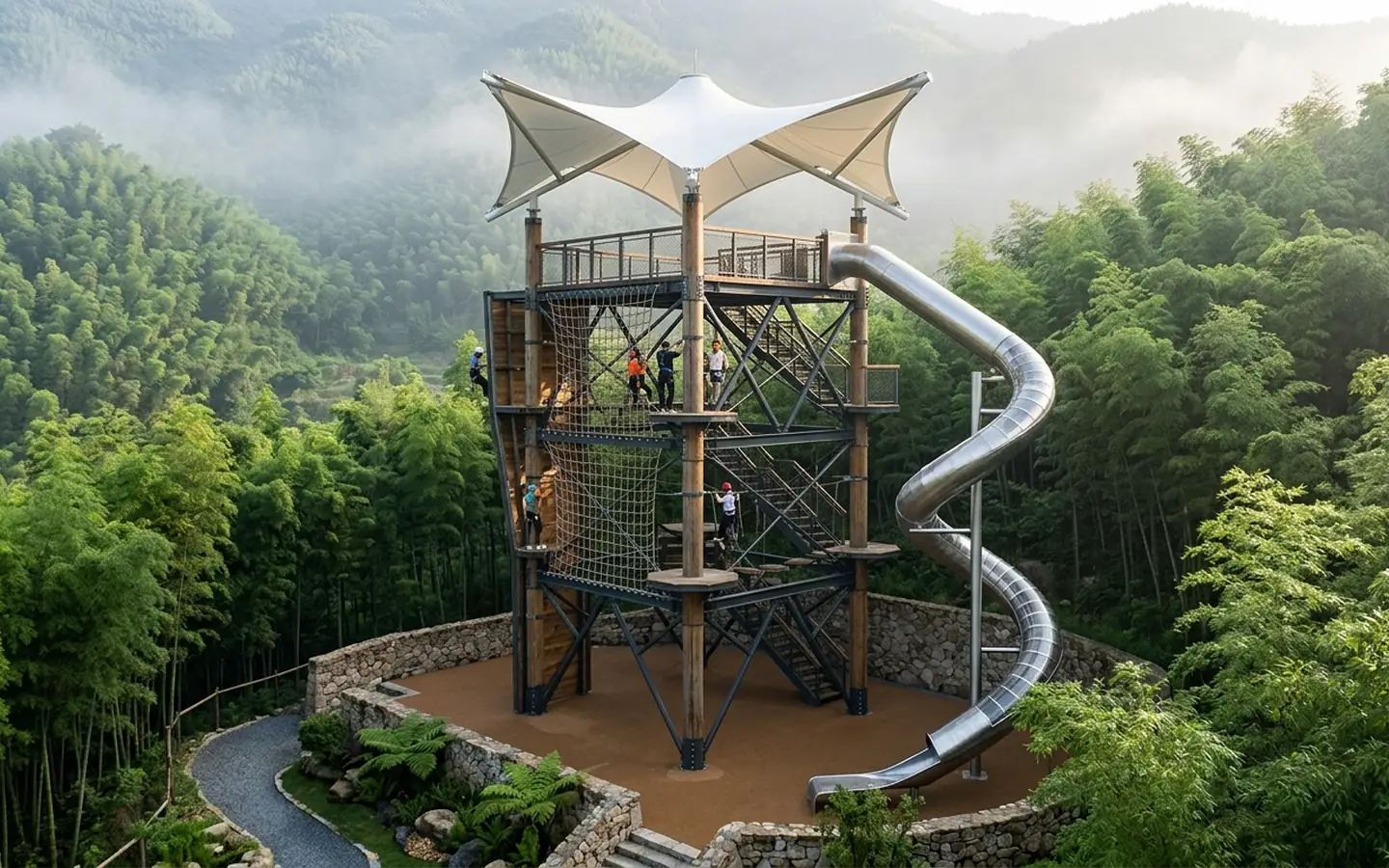
Why Multi-Level Vertical Towers Outperform Flat Spread-Out Playgrounds on ROI
Land grading, impact-attenuating surfacing, and perimeter fencing often consume 30% to 45% of an outdoor amusement park's capital budget. Stacking play activity vertically across two to three enclosed tiers multiplies playable capacity per square meter while creating a dramatic silhouette visible from parking areas and scenic access roads.
Sound Play®'s 2024 installation at Zhejiang Anji Honor Sky City demonstrates this vertical efficiency in practice: within a compact 448 m² hillside pad, our 15.80-meter three-level outdoor adventure tower integrates 60 progressive climbing, balancing, and skywalk activities—culminating in a high-throughput 9-meter 304 stainless steel slide under a white architectural PVDF canopy.
- Compact civil footprint: 400–600 m² can comfortably host 50–70 simultaneous adventure elements across 3 interconnected play tiers.
- Continuous loop circulation: parallel climb-up routes and dual egress slides prevent holiday queues and keep families engaged for 2–3+ hours.
- Zero-electricity operating model: pure kinetic non-power structures eliminate daily motor energy consumption and high-cost electromechanical downtime.
Structural Steel Framing, Wind Loads & PVDF Architectural Shade Canopies
Once an outdoor play tower exceeds 8 meters in elevation—particularly in coastal resorts, desert sunbelts, or mountain valleys—wind-load resistance, foundation overturning moments, and solar thermal comfort become primary engineering disciplines rather than afterthoughts.
At Sound Play®, primary load-bearing skeletal frames are fabricated from heavy-wall hot-dip galvanized structural steel (typically Ø140mm to Ø219mm columns) using automated laser cutting and robotic welding workstations, finished with UV-stabilized electrostatic powder coating. Topping the upper tier with an architectural PVDF tensioned membrane canopy delivers three simultaneous commercial benefits: lowering deck and slide surface temperatures in summer, shielding visitors from light mountain rain so ticket operations stay open, and giving the tower an iconic sculptural profile.
- Geotechnical & footing engineering: anchor-bolt foundation drawings are calibrated to site soil bearing capacity and regional wind-zone specifications.
- Zero-harness enclosed containment vs. belayed high-ropes: full-height stainless mesh or Ø16mm–Ø18mm 6-strand steel-core netting lets non-power towers run at high throughput without slow individual harness clipping.
- Pre-shipment trial assembly: critical structural nodes, skywalk flanges, and multi-meter stainless slide junctions undergo dry-fit inspection at our Wenzhou facility prior to container loading.
Safety Standards, Age Progression & Third-Party Inspection Readiness
Multi-level towers serve diverse family groups, so smart obstacle sequencing grades challenge progressively from ground-level balance bridges (suitable for ages 5–7) up to upper-deck rope tunnels and elevated skywalks (ages 8–14+ and accompanying parents), with clear emergency staff access hatches on every level.
Every Sound Play® outdoor adventure tower and rope course is engineered and manufactured in strict accordance with EN 1176 & ASTM F1487 safety standards; third-party inspection and certification support available. Backed by our factory's ISO 9001:2015, ISO 14001:2015, and OHSAS 18001 management certifications and China National Toy Quality Supervision & Inspection Center test reports, we supply complete CAD drawings, material specs, and on-site factory audit cooperation for buyer-designated SGS, TÜV, Intertek, or local municipal inspectors.
Engineered and manufactured in strict accordance with EN 1176 & ASTM F1487 safety standards; third-party inspection and certification support available.
Frequently Asked Technical Questions
What is the minimum footprint needed for a commercial three-level outdoor adventure tower?
A flagship 3-level tower matrix typically fits within 350 m² to 600 m² (for reference, our 15.80m Anji Honor Sky City tower integrates 60 activities and a 9m stainless slide on a 448 m² pad), plus perimeter clearance.
Do enclosed multi-level adventure towers require safety harnesses and large operational staff?
No. When engineered with full-height anti-climb stainless mesh or steel-core safety netting and enclosed 304 stainless steel egress slides, multi-level towers operate as high-capacity non-power play structures requiring only general floor supervision rather than individual harness belay operators.
Can PVDF tension canopies withstand coastal or mountain wind loads?
Yes. High-tensile architectural PVDF membranes are anchored to engineered galvanized steel perimeter masts and tension cables sized to your site's regional wind and snow load brief.
Engineering & Procurement Insights
Custom 304 Stainless Steel Slide Engineering Guide: Geometry, Wall Thickness & Atrium Integration
How commercial developers, landscape architects, and mall operators specify safe, long-lasting 304 stainless steel slides—from wall gauge and deceleration run-outs to thermal comfort and trial pre-assembly.
FEC Business StrategyTurnkey Indoor Trampoline Park & FEC Planning: Ceiling Heights, Zoning & ROI Drivers
Before signing a commercial retail lease for a trampoline park or family entertainment center, validate ceiling clearance, attraction mix, and parent hospitality zones to protect long-term unit economics.